
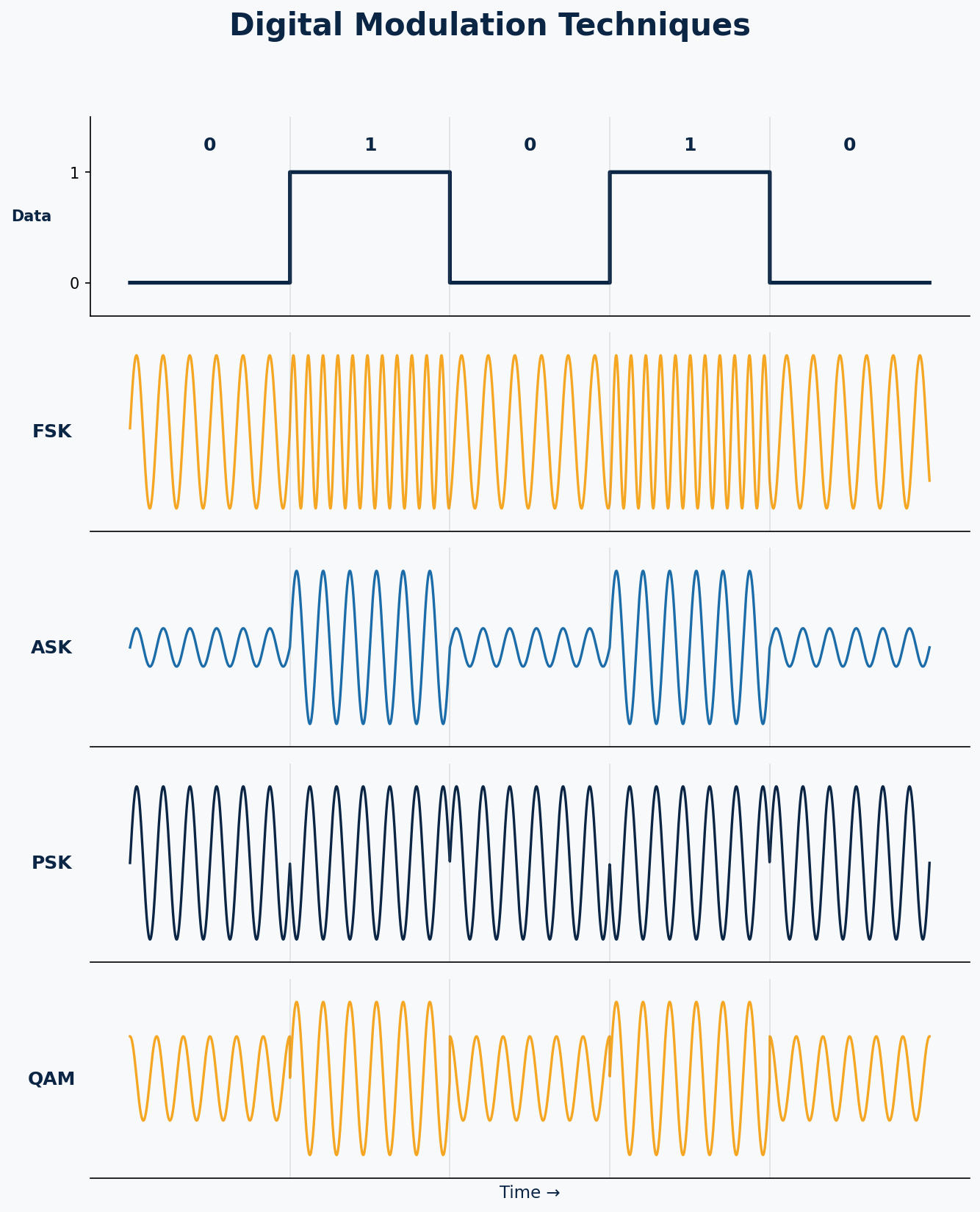
Digital modulation is how a stream of 0s and 1s gets carried over a radio wave, cable, or wireless link. A digital bit sequence is converted into one of several signal patterns for transmission — here are the four most common approaches.
Frequency Shift Keying (FSK) changes the carrier’s frequency depending on the bit value — a higher frequency for a 1, a lower one for a 0. It’s simple and holds up well against noise, which is part of why it’s so common in amateur digital modes.
Amplitude Shift Keying (ASK) instead varies the signal’s strength: a larger amplitude for a 1, smaller for a 0. It’s straightforward to implement, though generally less robust than the other methods.
Phase Shift Keying (PSK) keeps frequency and amplitude constant and shifts the carrier’s phase at specific points to encode data. This gives better performance in noisy conditions than ASK.
Quadrature Amplitude Modulation (QAM) combines amplitude and phase changes together, packing more data into the same bandwidth — the technique behind the higher data rates used in Wi-Fi, cable internet, and cellular networks.
Understanding these underpins a lot of what happens in modern digital amateur radio modes — worth knowing the basics of each as you explore digital operating.
Share This Story, Choose Your Platform!
LISTEN NOW

CAPTIVATING READS

Our blog is packed with articles and stories based around lifestyle, business, design and wellbeing. Subscribe now to get all of our updated directly to your inbox every week.