
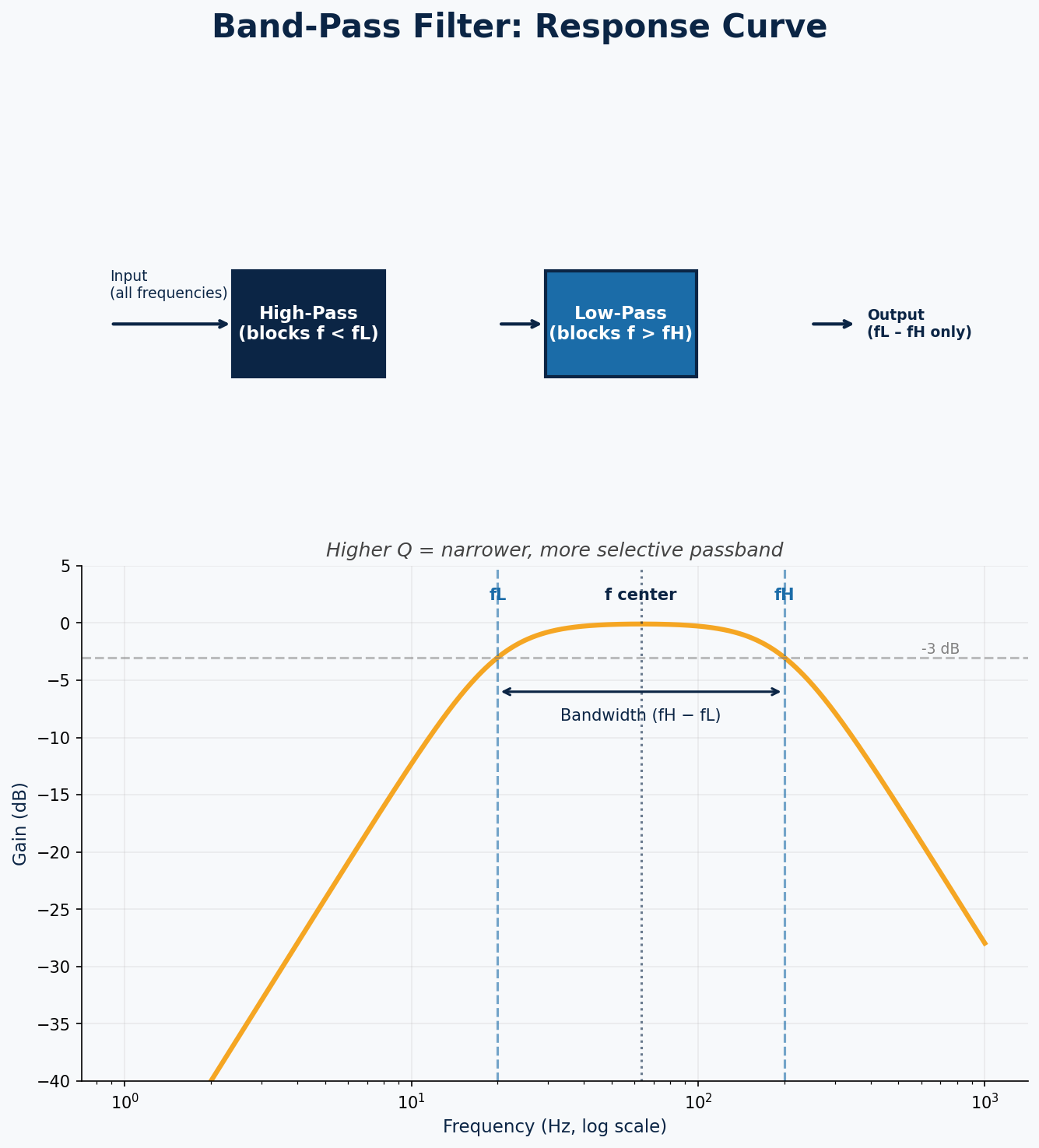
A band-pass filter is a circuit that lets a specific range of frequencies through while attenuating everything below and above that range. It’s essentially a high-pass and low-pass filter working together, which makes it a handy building block whenever you only want to keep one particular slice of a signal.
Two frequencies define the edges of that range: the lower cutoff (fL) and the upper cutoff (fH). The midpoint between them is the centre frequency (fcenter), and the gap between fH and fL is the bandwidth.
How sharply the filter separates “wanted” from “unwanted” frequencies is described by its Q factor (quality factor):
- A higher Q gives a narrower, more selective passband.
- A lower Q gives a wider, less selective passband.
Band-pass filters turn up everywhere in amateur radio and electronics generally — in receiver front-ends to reject out-of-band interference, in audio stages to isolate a wanted tone range, and generally anywhere you need to pull a useful signal out of a noisy environment.
Share This Story, Choose Your Platform!
LISTEN NOW

CAPTIVATING READS

Our blog is packed with articles and stories based around lifestyle, business, design and wellbeing. Subscribe now to get all of our updated directly to your inbox every week.