
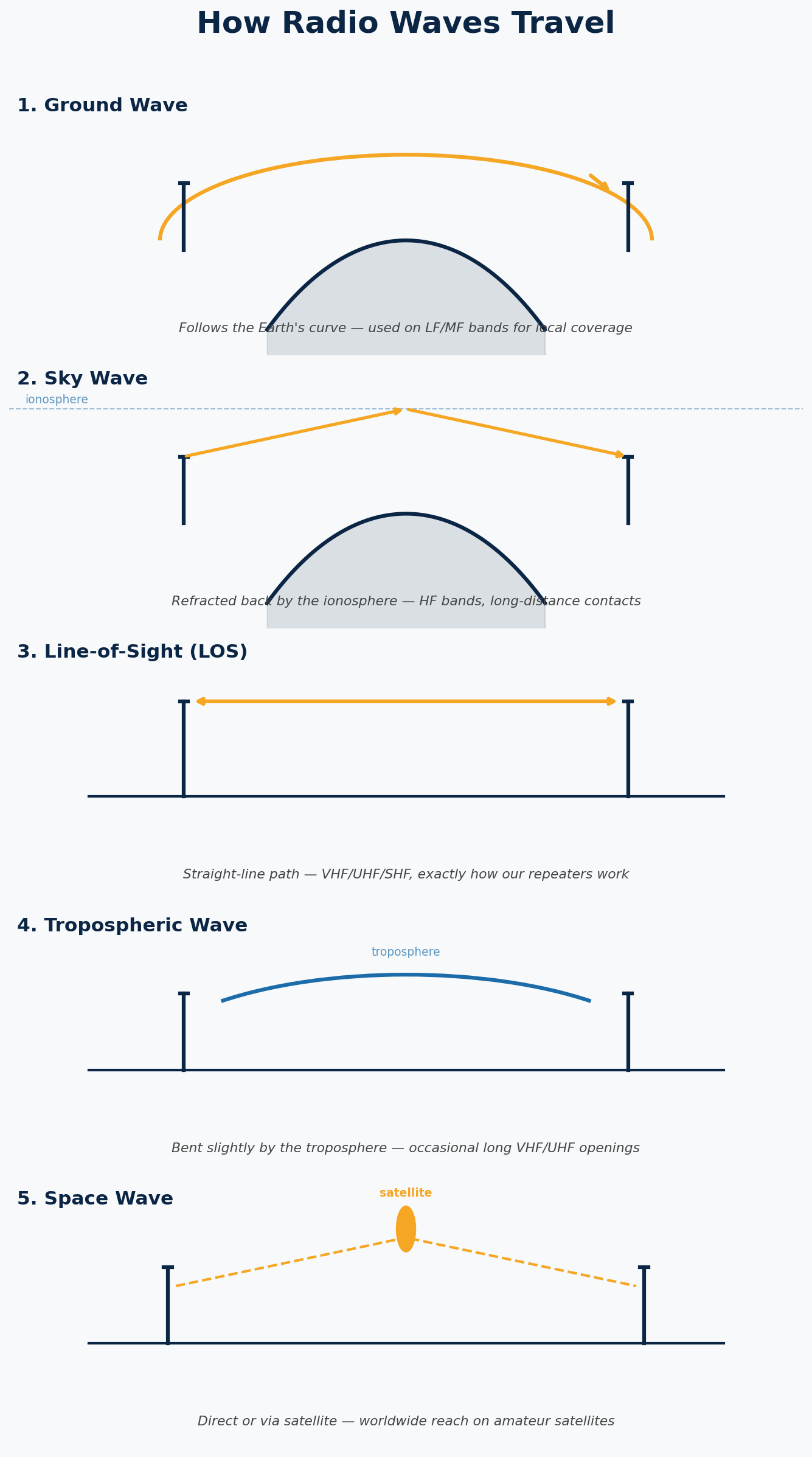
Understanding how radio waves travel from one antenna to another is one of the most useful things any amateur can learn — it shapes which band to choose, when to operate, and how far a signal is likely to reach. Here’s a quick rundown of the main propagation modes every operator should know.
Ground wave follows the curve of the Earth’s surface and is the workhorse of the LF and MF bands (30 kHz–3 MHz), giving reliable local and regional coverage.
Sky wave is what makes HF (3–30 MHz) so exciting: signals are refracted back down by the ionosphere, allowing contacts hundreds or even thousands of kilometres away without any satellite involved.
Line-of-sight (LOS) propagation covers VHF, UHF, SHF, and EHF, where signals travel in a straight path. This is exactly how our own repeaters and simplex contacts work, and why height and a clear line to the horizon matter so much on these bands.
Tropospheric propagation can occasionally stretch VHF/UHF range well beyond the normal horizon through ducting or troposcatter, especially under the right weather conditions — a fun one to watch for during a band opening.
Space wave covers everything from direct line-of-sight paths to contacts made via amateur radio satellites, opening the door to genuinely worldwide communication.
Knowing which mode is in play helps you pick the right band, antenna, and time of day for the contact you’re trying to make. A great topic to bring up at one of our sessions if you’d like to dig deeper.
Share This Story, Choose Your Platform!
LISTEN NOW

CAPTIVATING READS

Our blog is packed with articles and stories based around lifestyle, business, design and wellbeing. Subscribe now to get all of our updated directly to your inbox every week.